

The Architecture of Energy Independence
Orchestrating an Affordable Energy Transition Across the Greater Caribbean Region
The current state of the Caribbean energy market can be aptly described with a single word: fragmented.
Despite this, the demand for quality fuel and electricity in the region is uniformly high, and so are its energy prices. So achieving affordability for both businesses and the common consumer depends entirely on a shift from passive advocacy to aggressive execution.
That execution is being spearheaded by the stalwart leaders of the Caribbean Energy Chamber (CEC).
Launched in February 2024, the Caribbean Energy Chamber was founded to advocate for issues that hadn’t yet been addressed by the island-specific Energy Chambers in Trinidad, Suriname, and Guyana, which focused on more fossil-fuel-supply-centric issues.
“In terms of having an overarching entity that helps advocate for the wider Caribbean, which has a lot of issues more on the demand side related to tourism and energy efficiency for the small islands, they don’t really have an energy chamber to help them,” says Chairman of the CEC Board Melanie Chen.
In fact, the Chamber’s leadership identified energy efficiency as one of the most impactful areas of focus.
“Energy efficiency is fundamental. In any energy transition, you must first try to be more efficient with what you use and then augment it with more renewable supply,” explains CEC President Eugene Tiah.
As daunting a task as guiding an entire region through an energy transition may be, the CEC has rapidly established itself as a remarkably effective, non-profit coordinating force that bridges high-level strategy with foundational action.
It achieves this through the collaborative efforts of its Pan-Caribbean Board, which reflects most countries and stakeholders in the region.
Thanks to the CEC Board’s collective efforts, the Chamber has identified several structural barriers, like financing and project complexity, that have hindered past energy efforts.
Of course, every problem, when examined closely enough, yields a solution. In this case, it led the CEC to pilot a third-party Energy Service Company (ESCO) certification model for the advancement of energy efficiency projects.
This is just one of many areas that the Chamber has taken action on; rather than allowing critical energy initiatives to drown in the regional challenges of scale and geography, the CEC has taken a stand as a highly agile educator and enabler in the sector.

A Pragmatic Pivot Toward Impactful Implementation
Aside from energy efficiency, the Chamber’s other focus is capacity building. As a region of archipelagos and islands, it’s common for progress to stall due to a lack of technical or commercial resources.
As a solution, the CEC has invested in an online service tool on its website that connects businesses seeking such resources with suppliers capable of meeting their needs.
This streamlined digital platform serves as a central portal where resource-constrained municipal governments can instantly post technical vacancies and qualified regional specialists can submit credentials, creating a frictionless pipeline that addresses capacity gaps in real time as they arise.
This is an incredibly effective method for ensuring that highly impactful projects that can immediately move the economic needle don’t stall and drain public resources; more importantly, it should be seen as an essential component of the Chamber’s larger goal of a regional energy transition.
“What we’re trying to achieve is affordable net zero energy security… so we’re going to be very pragmatic in our approach,” Chen says, explaining that methods like the CEC’s online tool serve as a foundation for the larger plan.
An energy transition requires resources, and, just like energy efficiency, stable technical capacity is an indispensable building block that the CEC’s strategy has established.
This way, the Chamber will be able to advance both short- to medium-term solutions involving renewables and longer-term solutions involving policy, capital, and technological limitations.
As it relates to renewables, the starting point is low, with the region hovering around 10% total renewable energy penetration. However, CEC leadership’s perspectives lay out a very reasonable approach to growth.
“You need to look at proven technologies rather than possible technologies,” Chen says, citing solar, wind, hydro, and thermal as three short- to medium-term avenues with untapped potential.
Solar is by far the easiest to implement; however, the infrastructure’s resilience to hurricanes must be considered. Geographical feasibility must also be considered, as certain regions are simply better suited for certain renewables than others.
For example, areas like Dominica and St. Kitts & Nevis have immense potential for geothermal energy production.
Tiah comments on this potential, citing an ongoing 10 MW geothermal plant in Dominica, saying, “It should be up and running towards the end of 2026… and the result is that they will likely be able to deliver power to the population at around 12 to 15 cents per kilowatt hour, compared to the 30 to 40 cents they were delivering before.”

This would allow multiple regions to benefit from renewable energy sources while taking a more measured approach to implementing renewables that are currently less feasible, such as green hydrogen, which typically has production costs three to four times higher than geothermal energy.
Balancing Infrastructure Resilience with Capital Requirements
The argument for what’s probable in the energy sector certainly makes sense from the CEC’s practical perspective.
However, transforming the individual commercial entities that would physically build out this grid transition into highly efficient operations requires a radical reimagining of how capital is deployed and managed.
Small and medium-sized enterprises across the region frequently struggle to balance immediate operational expenditures with the long-term, high-upfront capital required to execute energy efficieny retrofits.
This is where the Chamber’s third-party ESCO model comes into play. This innovative framework effectively transfers the entire financial risk and balance-sheet burden from the business owner to an independent entity, which recoups its initial capital investment by taking a share of the documented monthly energy savings.
Through a series of educational webinars, the chamber is actively training the regional financing community, local corporate legal fraternities, and public-sector stakeholders to execute these complex performance contracts seamlessly.
But even with capital and resource capacity accounted for, the challenge of resilience remains. Affordable, renewable energy is only useful if it’s long-lasting, after all.
“There are many clever solutions that have emerged today; for example, there are collapsible wind turbines that can be secured during a severe weather event. And then we now have solar installations that are certified for category five hurricanes,” Tiah states, noting that while these options do have high upfront costs, the long-term benefit can be tremendous.
According to Tiah, establishing resilience doesn’t just mean having sturdier infrastructure. On the transmission side, the CEC advises municipal planners to prioritize burying primary trunk lines to accelerate post-storm recovery times.
So, for lower-GDP regions that may not yet have the option to invest in cutting-edge infrastructure, preserving those critical transmission assets might be the best solution.
Furthermore, a viable solution to energy security lies within the architecture of the grid itself.
The Chamber is driving a critical conversation away from vulnerable, fully centralized utility architectures and toward highly segmented distributed loops controlled by digital brain centers that can isolate damaged sectors and keep adjacent communities powered.
This conversation is necessary because, regardless of the region, if an isolated, centralized grid experiences a critical failure, it results in significant losses for multiple communities.
“For example, Jamaica, after their west coast event, is now giving serious attention to the idea of having a central system, because if your only arm goes down, then you’re completely down,” Tiah says, going on to use a recent disaster even in Texas, the only state in the U.S. without an interconnected grid, as another example.
“When you look at the failure analysis, one key takeaway is that Texas wouldn’t have been in such a dreadful situation if it had been interconnected with other states,” Tiah clarifies.
An Interconnected Future and Long-Term Security
As it relates to the Caribbean, the conversation around grid architectural design must be had on a case-by-case basis, as it carries over directly into the complex realm of cross-border interconnectivity.
While massive, pan-Caribbean subsea electrical grids have been proposed historically, the chamber’s detailed financial mapping showed that a comprehensive regional cable would cost between fifteen and thirty billion dollars.
Consequently, the association champions a highly pragmatic strategy focused on localized geographic pods.
“What we discussed at the Trinidad Sustainability Conference was that, rather than looking at the entire Caribbean region, maybe we could look at pods,” Chen states.
Under this framework, a southern pod consolidates Trinidad, Guyana, and Suriname; the middle pod unites the Eastern Caribbean states; and a separate northern network manages proximate local clusters.
“I think it makes more sense. It’s still an expensive exercise, but it makes more sense than trying to interconnect all of the islands,” Chen explains.
This localized approach allows island nations with dense geothermal baseload potential to seamlessly run subsea connections to adjacent islands situated within a short radius.
To complement these physical cables, the Inter-American Development Bank is advocating for a bundled, consolidated procurement approach, allowing disparate small nations to aggregate their market demand and drive down raw material costs.
Looking toward the next decade of regional development, the Chamber’s multi-faceted, efficiency-centered approach holds the potential to bring base electricity prices down from roughly 30 cents to 15 cents per kilowatt-hour.
For tourism-dependent islands, optimized power structures significantly lower the intense overhead of air conditioning, allowing local hotels to market a greener, highly competitive product to environmentally conscious global travelers.
“Affordable power unlocks advanced agricultural technologies such as hydroponics and vertical indoor farming, which rely heavily on automated water-circulation pumps and nutrient-delivery systems,” Tiah says, noting that this would directly unlock long-term food and water security across the region.
Lastly, the Chamber is considering advanced alternatives, such as small modular nuclear reactors, which are longer-term solutions to achieve true net-zero manufacturing.
Moving forward, the Caribbean Energy Chamber remains entirely committed to its role as a regional enabler.
An effective energy transition requires masterful coordination of many factors, and the CEC’s thoughtful strategies make it clear that the organization is best suited to building a secure, sovereign future.
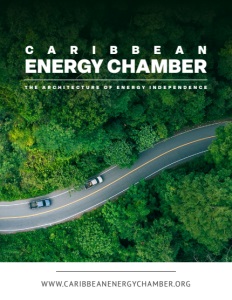
Click The Cover To View Or Download The Brochure
AT A GLANCE
Who: Caribbean Energy Chamber (CEC)
What: An agile, non-profit coordinating force and regional enabler dedicated to accelerating a pragmatic, net-zero energy transition, enhancing capacity building, and promoting demand-side energy efficiency across the region.
Where: Headquartered in St. Lucia, serving the wider Caribbean region
Website: www.caribbeanenergychamber.org
DIG DIGITAL?