
Educating with Expertise
Navigating the Future of Marine Studies
In an era defined by supply chain disruption, technological transformation, environmental challenges, and growing demand for highly skilled logistics professionals, the Caribbean Maritime University has positioned itself at the center of the conversation.
The institution is no longer simply preparing students for employment; it is helping to shape the future of maritime transportation, logistics management, engineering, artificial intelligence, environmental stewardship, and regional economic development.
At the heart of this transformation is a leadership team focused on stability, growth, and innovation. Through strategic investments, international partnerships, cutting-edge technology, and industry collaboration, the university continues to strengthen its role as a regional capacity-building hub while simultaneously expanding its influence across the wider Caribbean and beyond.
Building Capacity for National Development
One of the defining characteristics of the Caribbean Maritime University is its close alignment with Jamaica’s economic development priorities. Recognizing the country’s ambitions to strengthen logistics infrastructure and expand special economic zones, the university has actively developed programs designed to support those objectives.
A notable example is the institution’s Logistics 101 initiative, a program specifically designed to increase logistics and supply chain knowledge among participants throughout Jamaica. The program successfully trained hundreds of individuals and was structured in multiple phases to introduce participants to logistics operations, digitalization, and supply chain management.
“Then, he asked what our impact and support would be for the special economic zones, and we decided then that we’re going to create a program which we call Logistics 101,” explained Professor Ibrahim Ajaguna.
Ajaguna continued, “Before Melisa, we were able to train 600 participants across the country.”
The initiative reflects the university’s broader mission of serving national development priorities while creating pathways for workforce advancement. Through practical training, industry engagement, and targeted education programs, the Caribbean Maritime University is helping ensure Jamaica has the skilled professionals necessary to support increasingly sophisticated logistics operations.
Technology at the Core
As industries around the world accelerate their adoption of digital technologies, the Caribbean Maritime University has invested heavily in creating a technologically advanced learning environment that mirrors real-world industry conditions.
President Professor Andrew Spencer believes the institution’s technological capabilities represent one of its greatest strengths.
“So I’ll share a few of those with you. For example, we have what’s called our Festo didactic or Festo Fact Center, which is a didactic learning environment,” Spencer said.
The facility includes laboratories focused on pneumatics, hydraulics, mechatronics, Industry 4.0 technologies, electric vehicles, and advanced manufacturing systems. These environments provide students with direct exposure to technologies they will encounter in professional settings.
“And what does this do? It is teaching our students to peacefully coexist with technology. So they are learning higher-level skills while interacting with these technologies,” Spencer explained.
The university’s commitment to innovation extends well beyond traditional engineering laboratories. Students also gain access to sophisticated simulation technologies that replicate complex maritime and transportation environments.
“We have what we call our full bridge simulator, where students can engage in very real environments, multiple conditions, treacherous and otherwise, with real port conditions, bringing vessels into ports,” Spencer noted.
Additional facilities include engine room simulators, truck driving simulators, lifeboat simulators, high-voltage training environments, and 3D printing capabilities. These investments provide students with valuable hands-on experience while reducing risk and enhancing learning outcomes.
The institution’s forward-looking approach to technology is also reflected in its academic programming. The Caribbean Maritime University became the first university in the Caribbean to establish an artificial intelligence degree program, demonstrating a willingness to anticipate future workforce needs rather than simply respond to them.
Partnerships That Create Opportunity
A major factor behind the university’s success is its extensive network of partnerships spanning government agencies, private industry, regional organizations, and international institutions.
These relationships create meaningful opportunities for students while ensuring academic programs remain aligned with industry needs.
“We do have partnerships,” Spencer said. “The Port Authority is a partner. The Maritime Authority of Jamaica is a partner. We also have as partners the Jamaica Special Economic Zone Authority.”
The university’s partnerships extend deeply into the private sector as well.
“We have partnerships with the GraceKennedy Group. We have partnerships locally as well with Seprod. We have partnerships with the Jamaica Public Service. We have partnerships with New Fortress Energy,” Spencer explained.
These collaborations provide internship placements, apprenticeships, practical industry exposure, and employment opportunities for students.
“What this allows is for our students to have apprenticeships, internships,” Spencer said. “We send our staff on furlough assignments in these places as well, so that they too can be kept fully up to speed on the latest happenings in industry.”
The result is a highly connected educational ecosystem where students gain relevant experience before graduation, and employers gain access to a pipeline of skilled talent.
Expanding Beyond Borders
While Jamaica remains at the center of the university’s mission, the Caribbean Maritime University has increasingly embraced a regional and international outlook.
Ajaguna highlighted the institution’s growing presence throughout the Caribbean and beyond.
“What we have equally done in terms of this partnership is that we try to expand beyond our borders,” Ajaguna said.
One significant area of focus is Suriname, where the university is helping expand access to maritime education and professional training.
“We have extended it to Suriname, for example, where we look at expanding access to maritime education, not only in the Dutch-speaking Caribbean, but also the French-speaking Caribbean,” Ajaguna explained.
The university is also an associate member of the Port Management Association of the Caribbean, serving as a training partner for ports throughout the Eastern Caribbean.
“With this, we try to strengthen our cross-border maritime workforce integration,” Ajaguna said.
The impact of these efforts can already be seen throughout the region.
“If you go to all these ports in the Eastern Caribbean, at least you will find one or two graduates of CMU who are in high positions,” Ajaguna noted.
International collaborations continue to grow through initiatives such as the Erasmus program, which facilitates faculty and student mobility between the Caribbean Maritime University and European institutions.
The university is also collaborating with French partners to develop degree programs focused on marine environmental management and protection under broader Blue Economy initiatives.
Investing in the Future
Continuous investment remains central to the university’s growth strategy.
As technology evolves rapidly, university leadership recognizes the importance of maintaining state-of-the-art facilities and systems.
“This year we are looking to upgrade much of the technology,” Spencer said.
The university plans to modernize key simulation platforms while simultaneously enhancing administrative systems through improvements to student registration and operational processes.
Beyond technology, significant attention is being directed toward physical expansion.
“We’re also about to embark on looking at construction projects,” Spencer explained.
Plans include expanding operations into additional Jamaican parishes, including Clarendon and St. Thomas, while exploring opportunities to establish a stronger long-term presence in Suriname.
Strong support from government stakeholders, combined with diversified revenue streams from professional certification programs and research initiatives, has provided the financial foundation necessary to pursue these ambitious plans.
Recognition Through Results
Perhaps the strongest indicator of the Caribbean Maritime University’s success is the growing demand for its graduates.
Despite challenges created by the pandemic and severe weather events, the institution has achieved impressive enrollment growth over recent years.
“In 2022, we saw the biggest fall in our student numbers,” Spencer recalled.
However, the university’s strategic planning efforts soon produced measurable results.
“After year one, we saw a 42 percent increase in new student numbers. After year two, we saw a further 18 percent increase on that 42 percent. And this year, we’ve seen another 15 percent increase,” Spencer explained.
The growth reflects increasing recognition of the university’s value proposition among students, employers, and international partners.
Applicants now come from countries across the Caribbean, Africa, Europe, and Asia, further strengthening the institution’s global profile.
Industry confidence has also reached new heights.
Spencer described a partnership model where employers actively recruit students before graduation.
“They want to establish a program that identifies the best students at year two, takes them into a program, pays their tuition for years three and four, takes them every summer in an apprenticeship, and upon graduation, they have a job guaranteed,” Spencer said while discussing one corporate partnership.
Even organizations outside traditional maritime sectors are recognizing the value of the university’s graduates.
“The National Commercial Bank has reached out to say, we know you’re a logistics and a maritime university, but we want your best logisticians. We want your best engineers because we want solutions,” Spencer noted.
A Voice in Global Maritime Policy
Looking ahead, the Caribbean Maritime University is focused not only on educating future professionals but also on influencing important policy discussions affecting the maritime industry and the environment.
One major priority is addressing the global shortage of seafarers.
“The world is demanding over 90,000 seafarers right now,” Spencer said.
The university is exploring ways to increase training capacity while maintaining educational quality.
At the same time, the institution is deepening its role in environmental research and sustainability initiatives.
One of its most significant projects involves research into sargassum seaweed through a partnership supported by Irish Aid.
“We’re looking at biodiversity surrounding what would normally be considered a nuisance in sargassum seaweed. What can we use it for? How can we harness it?” Spencer explained.
The university is also playing an important role in international discussions surrounding shipping emissions and fuel efficiency through projects connected to the International Maritime Organization.
These initiatives position the Caribbean Maritime University as both a center of education and a source of research-driven solutions for some of the industry’s most pressing challenges.
Charting the Next Course
The story of the Caribbean Maritime University is ultimately one of transformation, resilience, and ambition. Through strategic leadership, technological innovation, international collaboration, and an unwavering commitment to workforce development, the institution has emerged as one of the Caribbean’s most influential educational organizations.
Its graduates are helping operate ports, manage logistics networks, engineer solutions, and shape policy discussions throughout the region and beyond. Its researchers are contributing to conversations about sustainability, environmental stewardship, and maritime innovation. Its partnerships continue to create opportunities that extend far beyond the classroom.
As global trade becomes increasingly interconnected and the maritime sector continues to evolve, the Caribbean Maritime University appears exceptionally well-positioned to meet the moment. By preparing students not simply for today’s jobs but for tomorrow’s challenges, the university is helping chart a course toward a more innovative, sustainable, and prosperous future for Jamaica, the Caribbean, and the wider maritime world.
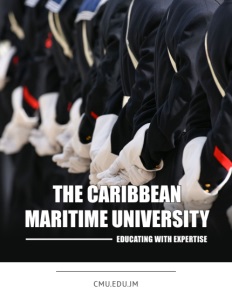
Click The Cover To View Or Download The Brochure
AT A GLANCE
Who: The Caribbean Maritime University
What: A leading Marine educational institution that is focused on logistics, innovation, and workforce development for the sector
Where: Kingston, Jamaica
Website: www.cmu.edu.jm
PREFERRED VENDORS/PARTNERS

Mona Graphic Printers Company Ltd. : www.mgprinters.com
Established in 1993, Mona Graphic Printers Company Limited is one of Jamaica’s leading print and graphics providers. Specializing in commercial printing, packaging, signage, large format graphics, and installation services, MGP partners with organizations across multiple industries to deliver innovative, reliable, and high-quality branding and communication solutions.
DIG DIGITAL?